
WASHINGTON, Dec. 8, 2014 -- There's probably a box of it in your fridge or cupboard, and it has a million uses: baking soda. Reactions is back with volume four of its popular Chemistry Life Hacks series, with tips on how to de-skunk your dog, clean your kitchen and supercharge your washing machine. Check out the latest in the series that's one-part MacGyver, one-part Mendeleev here: http://youtu.be/85diRmuk-ow.
Earth
Insects are full of marvels - and this is certainly the case with a beetle from the Tenebrionind family, found in the extreme conditions of the Namib desert. Now, a team of scientists has demonstrated that such insects can collect dew on their backs - and not just fog as previously thought. This is made possible by the wax nanostructure on the surface of the beetle's elytra. These findings by José Guadarrama-Cetina, then working at ESPCI ParisTech, France - on leave from the University of Navarra, in Spain - and colleagues were recently published in EPJ E.
Gallium nitride (GaN) based devices are attractive for harsh environment electronics because of their high chemical and the mechanical stability of GaN itself that has a higher atomic displacement energy than other semiconductor materials.
However, degradation mechanisms of GaN device under radiation environments is not clear mainly because devices consist of many different types of semiconductors, such as p-type and n-type layers in light emitting diode (LED), and each layer has different hardness to radiation.
The ability to predict macroscopic physical and chemical properties from information derived at the micro-scale or atomic scale for various kinds of materials has yet to be perfected in the field of materials physics and chemistry. Although macro-scopic properties are determined by the micro or atomic structure of materials, it is still difficult to obtain such properties as hardness, intensity, surface tension, density, thermal expansion, thermal diffusion, viscosity and specific heat from a cell with just several atoms because of multi-scale effects.
UPTON, NY-A team of scientists from the U.S. Department of Energy's (DOE) Brookhaven National Laboratory, Columbia Engineering, Columbia Physics and Kyoto University has discovered an unusual form of electronic order in a new family of unconventional superconductors.
ANN ARBOR--An odd, iridescent material that's puzzled physicists for decades turns out to be an exotic state of matter that could open a new path to quantum computers and other next-generation electronics.
Physicists at the University of Michigan have discovered or confirmed several properties of the compound samarium hexaboride that raise hopes for finding the silicon of the quantum era. They say their results also close the case of how to classify the material--a mystery that has been investigated since the late 1960s.
As California finally experiences the arrival of a rain-bearing Pineapple Express this week, two climate scientists from the University of Minnesota and Woods Hole Oceanographic Institution have shown that the drought of 2012-2014 has been the worst in 1,200 years.
The El Niño Southern Oscillation is Earth's main source of year-to-year climate variability, but its response to global warming remains highly uncertain.
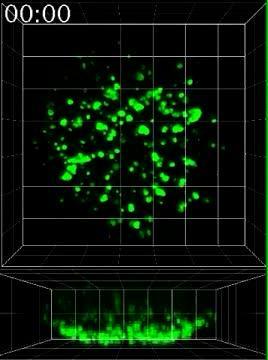
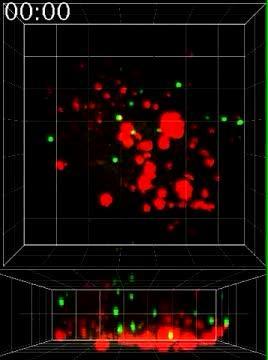
Nucleoli (green), small liquid-like nuclear bodies, are kept small and afloat by a fine actin mesh. When the mesh breaks, the nucleoli quickly being to fall and coalesce into larger droplets at the bottom of the nucleus. The grid size is 50 microns.
(Photo Credit: Marina Feric and Cliff Brangwynne, Princeton University)
An international team, including scientists from Arizona State University, the University of Milwaukee-Madison (UMW), and Germany's Deutsches Elektronen-Synchrotron (DESY), have caught a light sensitive biomolecule at work using an X-ray laser. Their new study proves that high speed X-ray lasers can capture the fast dynamics of biomolecules in ultra slow-motion, revealing subtle processes with unprecedented clarity.
Vienna, Austria - 5 December 2014: New 3D printed heart technology could reduce the number of heart surgeries in children with congenital heart disease, according to Dr Peter Verschueren who spoke on the topic today at EuroEcho-Imaging 2014.1 Dr Verschueren brought 3D printed models of the heart to his lecture including models used to plan real cases in patients.
EuroEcho-Imaging is the annual meeting of the European Association of Cardiovascular Imaging (EACVI), a branch of the European Society of Cardiology (ESC), and is held 3-6 December in Vienna, Austria.
Magnetite (or Fe3O4) is an elaborate kind of rust - a regular lattice of oxygen and iron atoms. But this material plays an increasingly important role as a catalyst, in electronic devices and in medical applications.
CORVALLIS, Ore. - Scientists may have solved a long-standing enigma known as the African Humid Period - an intense increase in cumulative rainfall in parts of Africa that began after a long dry spell following the end of the last ice age and lasting nearly 10,000 years.
In a new study published this week in Science, an international research team linked the increase in rainfall in two regions of Africa thousands of years ago to an increase in greenhouse gas concentrations. The study was funded by the National Science Foundation and the U.S. Department of Energy.
A long-held assumption about the Earth is discussed in today's edition of Science, as Don L. Anderson, an emeritus professor with the Seismological Laboratory of the California Institute of Technology, and Scott King, a professor of geophysics in the College of Science at Virginia Tech, look at how a layer beneath the Earth's crust may be responsible for volcanic eruptions.
The discovery challenges conventional thought that volcanoes are caused when plates that make up the planet's crust shift and release heat.
The bacterium Salmonella Typhi causes typhoid fever in humans, but leaves other mammals unaffected. Researchers at University of California, San Diego and Yale University Schools of Medicine now offer one explanation -- CMAH, an enzyme that humans lack. Without this enzyme, a toxin deployed by the bacteria is much better able to bind and enter human cells, making us sick. The study is published in the Dec. 4 issue of Cell.