
A new study published in the journal Science says that the total impact of switching to natural gas depends heavily on leakage of methane (CH4) during the natural gas life cycle, and suggests that more can be done to reduce methane emissions and to improve measurement tools which help inform policy choices.
Earth
In a recent early online edition of Nature Chemistry, ASU scientists, along with colleagues at Argonne National Laboratory, have reported advances toward perfecting a functional artificial leaf.
Designing an artificial leaf that uses solar energy to convert water cheaply and efficiently into hydrogen and oxygen is one of the goals of BISfuel – the Energy Frontier Research Center, funded by the Department of Energy, in the Department of Chemistry and Biochemistry at Arizona State University.
In May 2011, when the U.S. Army Corps of Engineers used explosives to breach a levee south of Cairo, Ill., diverting the rising waters of the Mississippi and Ohio rivers to prevent flooding in the town, about 130,000 acres of Missouri farmland were inundated. It was the largest flood of the lower Mississippi ever recorded, and researchers from the University of Illinois at Urbana-Champaign took advantage of this "once-in-a-scientific-lifetime" occurrence to study the damage, funded by a National Science Foundation Rapid Response Grant.
Spraying reflective particles into the atmosphere to reflect sunlight and then stopping it could exacerbate the problem of climate change, according to new research by atmospheric scientists at the University of Washington.
Carrying out geoengineering for several decades and then stopping would cause warming at a rate that will greatly exceed that expected due to global warming, according to a study published Feb. 18 in Environmental Research Letters.
Winter in the Arctic is not only cold and dark, it is also storm season when hurricane-like cyclones traverse the northern waters from Iceland to Alaska. These cyclones are characterized by strong localized drops in sea level pressure, and as Arctic-wide decreases in sea level pressure are one of the expected results of climate change, this could increase extreme Arctic cyclone activity, including powerful storms in the spring and fall.
HOUSTON – (Feb. 17, 2014) – A single-walled carbon nanotube grows from the round cap down, so it's logical to think the cap's formation determines what follows. But according to researchers at Rice University, that's not entirely so.
Theoretical physicist Boris Yakobson and his Rice colleagues found through exhaustive analysis that those who wish to control the chirality of nanotubes – the characteristic that determines their electrical properties – would be wise to look at other aspects of their growth.
WASHINGTON D.C. Feb. 18, 2014 -- By exploring how creatures in nature are able to fly by flapping their wings, Virginia Tech researchers hope to apply that knowledge toward designing small flying vehicles known as "micro air vehicles" with flapping wings.
Researchers at the Helmholtz-Zentrum Dresden-Rossendorf (HZDR) have tested a new approach to fabricating spin valves. Using ion beams, the researchers have succeeded in structuring an iron aluminium alloy in such a way as to subdivide the material into individually magnetizable regions at the nanometer scale. The prepared alloy is thus able to function as a spin valve, which is of great interest as a candidate component for use in spintronics.
As a range of climate change mitigation scenarios are discussed, University of Washington researchers have found that the injection of sulfate particles into the atmosphere to reflect sunlight and curb the effects of global warming could pose a severe threat if not maintained indefinitely and supported by strict reductions in greenhouse gas (GHG) emissions.

Enabled by the birefringence of liquid crystal, motion of 24nm thick bacteria flagella now is easily visible using a simple polarizing microscope.
(Photo Credit: S. Zhou, A. Sokolov, O. Lavrentovich and I. Aranson)
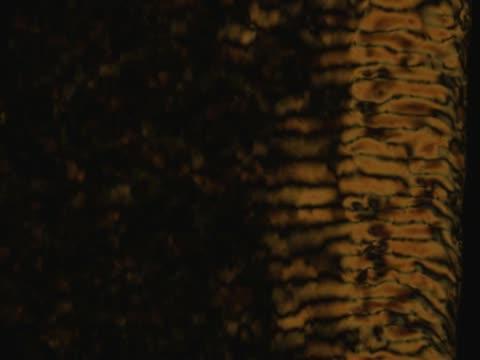
Even at low Reynolds number, active bacteria can create periodic patterns when swimming in the viscoelastic liquid crystal.
One of science's strongest dogmas is that complex life on Earth could only evolve when oxygen levels in the atmosphere rose to close to modern levels. But now studies of a small sea sponge fished out of a Danish fjord shows that complex life does not need high levels of oxygen in order to live and grow.
The dramatic images of natural disasters in recent years, including hurricanes Katrina and Sandy and the Tohoku, Japan, earthquake and tsunami, show that nature, not the people preparing for hazards, often wins the high-stakes game of chance.
"We're playing a high-stakes game against nature without thinking about what we're doing," geophysicist Seth Stein of Northwestern University said. "We're mostly winging it instead of carefully thinking through the costs and benefits of different strategies. Sometimes we overprepare, and sometimes we underprepare."
EAST LANSING, Mich. — Grasping the concept of climate change and its impact on the environment can be difficult. Establishing common ground and using models, however, can break down barriers and present the concept in an easily understood manner.
In a presentation at this year's meeting of the American Association for the Advancement of Science, Michigan State University systems ecologist and modeler Laura Schmitt-Olabisi shows how system dynamics models effectively communicate the challenges and implications of climate change.
A new study led by University of Minnesota researchers demonstrates that fertilization of natural grasslands -- either intentionally or unintentionally as a side effect of global farming and industry -- is having a destabilizing effect on global grassland ecosystems. Using a network of natural grassland research sites around the world called the Nutrient Network, the study represents the first time such a large experiment has been conducted using naturally occurring sites.
Forecasts of when a volcano is ready to erupt could be a little closer thanks to work bygeologists at the University of California, Davis, and Oregon State University published online Feb.16 in the journal Nature.
For an eruption to occur, the magma, or molten rock under the volcano must be sufficientlymobile to erupt.
"The question is, what percentage of time is the magma in an eruptible state?" said KariCooper, associate professor in the Department of Earth and Planetary Sciences at UC Davis and leadauthor on the paper.