
In this month's issue of Physics World, Felicity Mellor, a senior lecturer in science communication at Imperial College London, questions whether the requirement of the modern physicist to collaborate and communicate is preventing the intellectual progress brought about by silence and solitude.
Earth
Alexandria, Va. – Turtles are the last major living vertebrate group to be placed firmly on the tree of life, and the arguments are getting messy. Three fields in particular — paleontology, developmental biology and microbiology/genomics — disagree about how, and from what, turtles may have evolved.
After several years of discussions, researchers from Aarhus University (Denmark), Lund University (Sweden) and Stockholm University (Sweden) have determined that nutrients from the land are the main cause of widespread areas of oxygen depletion. The results were published on 31 March in the prestigious American journal Proceedings of the National Academy of Sciences.
Nutrients are the villain
Increasing heat is expected to extend dry conditions to far more farmland and cities by the end of the century than changes in rainfall alone, says a new study. Much of the concern about future drought under global warming has focused on rainfall projections, but higher evaporation rates may also play an important role as warmer temperatures wring more moisture from the soil, even in some places where rainfall is forecasted to increase, say the researchers.
WASHINGTON, March 31, 2014 — It's almost April Fools' Day, and the American Chemical Society's (ACS') Reactions video series is celebrating with an episode featuring our favorite chemistry jokes. Which two elements look cute together? Why is father water concerned about his "iced out" son? What do you get when you combine sulfur, tungsten and silver? Get all the punchlines in the latest Reactions episode, available at: http://youtu.be/C5RZRkhk0OM.
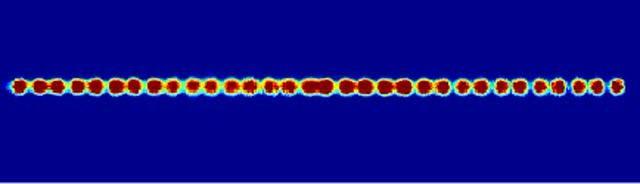
Physicists from New Zealands' University of Otago have pushed the frontiers of quantum technology by developing a steerable 'optical tweezers' unit that uses intense laser beams to precisely split minute clouds of ultracold atoms.
Here the researchers use the technology to split a single ultracold cloud of rubidium atoms sequentially into 32 daughter clouds, spreading them out over nearly half a centimetre.
(Photo Credit: Niels Kjaergaard)
A study in The Journal of General Physiology provides new evidence that the ubiquitous sodium pump is more complex—and more versatile—than we thought.
The sodium pump is present in the surface membrane of all animal cells, using energy derived from ATP to transport sodium and potassium ions in opposite directions across the cell boundary. By setting up transmembrane gradients of these two ions, the pump plays a vital role in many important processes, including nerve impulses, heartbeats, and muscular contraction.
Greenhouse gas emissions from food production may threaten the UN climate target of limiting global warming to 2 degrees Celsius, according to research at Chalmers University of Technology, Sweden.
On Monday 31 March the Intergovernmental Panel on Climate Change (IPCC) presents their report on the impacts of climate change.
"Obviously, we cannot go inside of the Earth to see what is happening there. However, the process of mantle convection should comply with fundamental physics laws, such as conservation of mass, momentum and energy. What we have done is to simulate the process of mantle convection by solving the equations which controls the process of mantle convection," says Li.
Pioneering new research from the University of Exeter could have a major impact on climate and environmental science by drastically transforming the perceived reliability of key observations of precipitation, which includes rain, sleet and snow.
The ground breaking study examines the effect that increased aerosol concentrations in the atmosphere, emitted as a result of burning fossil fuels, had on regional temperature and precipitation levels.
Chemists at the Ruhr-Universität Bochum (RUB) have, for the first time, completely analysed the fingerprint region of the Terahertz spectrum of a biologically relevant molecule in water, in this case, an amino acid. By combining spectroscopy and molecular-dynamics simulations, they rendered the motion of the most basic amino acid, glycine, visible in an aqueous solution. Their results have disproved the long-standing theory that frequencies in the Terahertz range provide no information regarding the amino acid's motion.
The largest earthquakes occur where oceanic plates move beneath continents. Obviously, water trapped in the boundary between both plates has a dominant influence on the earthquake rupture process. Analyzing the great Chile earthquake of February, 27th, 2010, a group of scientists from the GFZ German Research Centre for Geosciences and from Liverpool University found that the water pressure in the pores of the rocks making up the plate boundary zone takes the key role (Nature Geoscience, 28.03.2014).
Scientists at the National Snow and Ice Data Centre (NSIDC), University College London, University of New Hampshire and University of Washington analysed 300 summer Arctic sea ice forecasts from 2008 to 2013 and found that forecasts are quite accurate when sea ice conditions are close to the downward trend that has been observed in Arctic sea ice for the last 30 years. However, forecasts are not so accurate when sea ice conditions are unusually higher or lower compared to this trend.
A new time-lapse animation of data from NOAA's GOES-East satellite provides a good picture of why the U.S. East Coast experienced a snowier than normal winter. The new animation shows the movement of storms from January 1 to March 24.
NOAA's Geostationary Operational Environmental Satellites or GOES-East imagery from January 1 to March 24 was compiled into three videos made by NASA/NOAA's GOES Project at NASA's Goddard Space Flight Center in Greenbelt, Md. The time-lapse videos run at different speeds: 0:41 seconds, 1:22 minutes and 2:44 minutes.