
A proven system for verifying that apparent nuclear weapons slated to be dismantled contained true warheads could provide a key step toward the further reduction of nuclear arms. The system would achieve this verification while safeguarding classified information that could lead to nuclear proliferation.
Earth
If no further action is taken and global temperature increases by 3.5°C, climate damages in the EU could amount to at least €190 billion, a net welfare loss of 1.8% of its current GDP. Several weather-related extremes could roughly double their average frequency. As a consequence, heat-related deaths could reach about 200 000, the cost of river flood damages could exceed €10 billion and 8000 km2 of forest could burn in southern Europe. The number of people affected by droughts could increase by a factor of seven and coastal damage, due to sea-level rise, could more than triple.
Skyrmions, subatomic quasiparticles that could play a key role in future spintronic technologies, have been observed for the first time using x-rays. An international collaboration of researchers working at Berkeley Lab's Advanced Light Source (ALS) observed skyrmions in copper selenite (Cu2SeO3) an insulator with multiferroic properties. The results not only hold promise for ultracompact data storage and processing, but may also open up entire new areas of study in the emerging field of quantum topology.
Source:
In an important development for the health of elderly people, University of Liverpool researchers have developed a new method to target bone growth.
As people age their bones lose density and, especially in women after the menopause, become more brittle. The new method developed by researchers from the University's Institute of Ageing and Chronic Disease offers the possibility of more effective treatment than currently available.
There are many open questions that the Standard Model cannot answer. One of them is the smallness of the Higgs expectation value vh compared with the Planck scale. In their latest work, Dr Yuta Hamada, Dr Hikaru Kawai and Dr Kiyoharu Kawana at Kyoto University, consider the radiation S of the universe at the late stage as a function of vh, and they show that S reaches its maximum around the observed value vh = 246 GeV.
The rate of deforestation in the Brazilian Amazon has declined.
An international team of scientists, including one from Virginia Tech, reviewed published research about policy interventions and commodity market effects, and determined that positive incentives for farmers, counties, and states can do as much to preserve forests as public policies that call for penalties.
This past January, Derek Ahneman, a graduate student in the lab of Abigail Doyle, a Princeton University associate professor of chemistry, began work on an ambitious new project: he proposed the merger of two areas of research to enable a powerful reaction that neither could broadly achieve on its own.
Boulder, Colo., USA - Three main rivers -- the Ganges, Brahmaputra, and Meghna -- meet in the Bengal basin to form the world's largest delta system, which serves as a gateway between the Himalayan mountains and the vast, deep-ocean Bengal Fan. This GSA BULLETIN paper by Stephen Goodbred and colleagues presents a new understanding of how this mega-delta, the Ganges-Brahmaputra-Meghna delta, came together over the past 10,000 years.
WASHINGTON D.C., June 24, 2014 – "Ghost imaging" sounds like the spooky stuff of frivolous fiction, but it's an established technique for reconstructing hi-res images of objects partly obscured by clouds or smoke. Now a group of researchers at the National University of Singapore (NUS) is applying the same idea in reverse to securing stored or shared electronic data.
WASHINGTON D.C., June 24, 2014 – Can emotional states be measured quantitatively, and if so what would advertising, manufacturing and social media companies do with that data? Imagine a world in which a consumer's real-time physical and emotional response helped to determine his/her experience of music, online ads or the temperature in the room.
Around 165 million years ago, a spectacular parasite was at home in the freshwater lakes of present-day Inner Mongolia (China): A fly larva with a thorax formed entirely like a sucking plate. With it, the animal could adhere to salamanders and suck their blood with its mouthparts formed like a sting. To date no insect is known that is equipped with a similar specialised design. The international scientific team is now presenting its findings in the journal "eLIFE".
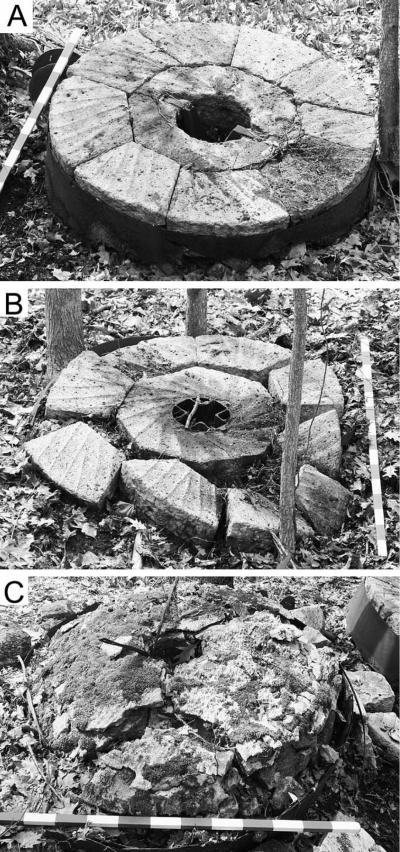
Tulsa, Ok. – The Society for Sedimentary Geology (SEPM) announces an unusual paper in their journal PALAIOS that combines 'forensic' paleontology and archeology to identify origins of the millstones commonly used in the 1800's. While all millstones were used similarly, millstones quarried in France were more highly valued than similar stones quarried in Ohio, USA.
Ricardo Holdo, a savanna ecologist and assistant professor of biological sciences at the University of Missouri, said that the researchers present enough data to potentially determine the amount of pastureland that wild Sodom-apple eaters would be able to keep free of the noxious plant. Holdo, who is familiar with the research but had no role in it, said that beyond removing the Sodom apple, animals such as elephants and impalas could potentially increase the food available to cattle.
WASHINGTON, June 23, 2014 — In this week's episode, Reactions is getting sexy. Our latest video highlights the ways chemistry has made sex safer and (in one surprising case) spicier. From latex condoms to warming lubricants, birth control to emergency contraception, chemistry plays a big role in the bedroom, and not just the chemistry between you and your partner. The video is available at http://youtu.be/54-rMC_67TM.