
Source:
Earth
Source:
At 11 p.m. EDT on Sunday, September 14, Tropical Depression 16-E was officially a remnant low pressure area. NOAA's GOES-West satellite showed the clouds associated with the remnants being drawn into the massive circulation of nearby Hurricane Odile.
WASHINGTON, Sept. 15, 2014 — By now, we've got all the details about Apple's latest iPhone, and the lines are probably forming somewhere for the Sept. 19 launch. But what do you really know about the guts of the iPhone 6, or any smartphone for that matter? Reactions teamed up once again with the Compound Interest blog to reveal the chemical elements found inside your smartphone. Learn all about it at http://youtu.be/66SGcBAs04w.
Conditions on Earth for the first 500 million years after it formed may have been surprisingly similar to the present day, complete with oceans, continents and active crustal plates.
This alternate view of Earth's first geologic eon, called the Hadean, has gained substantial new support from the first detailed comparison of zircon crystals that formed more than 4 billion years ago with those formed contemporaneously in Iceland, which has been proposed as a possible geological analog for early Earth.
Researchers in Sydney and Newcastle, Australia have found that elements of dust, particularly those coarse particles that contain iron traces, stimulate the production of inflammatory molecules in cells from the airways of mice and healthy human volunteers. Surprisingly, traffic fume pollutants did not cause these changes. The findings are featured in a new Respirology study.
In an unprecedented evolution experiment scientists from GEOMAR Helmholtz Centre for Ocean Research Kiel and the Thünen Institute of Sea Fisheries have demonstrated for the first time, that the single most important calcifying algae of the world's oceans, Emiliania huxleyi, can adapt simultaneously to ocean acidification and rising water temperatures. In their study, the researchers found no evidence for the widespread idea that evolutionary adaptations to these two aspects of climate change would interfere with each other.
"The results will allow us to better understand how the fish communities might shift under different climate change scenarios and provide the type of environmental data to inform future decisions relating to the management and siting of protected areas," said Paula Whitfield, a research ecologist at NOAA's National Centers for Coastal Ocean Science (NCCOS) and lead author of the study.
The creation of the Vuoksi River and the subsequent rapid decrease in the water level of Lake Saimaa approximately 6,000 years ago revealed thousands of square kilometres of new, fertile land in eastern Finland. A multidisciplinary research project organised by University of Helsinki researchers has studied the role that the decrease in water levels has played in the interaction between nature and humans. After dramatic shifts in the waterways, human life in the area underwent significant changes and gave rise to a new, innovative culture.
Source:
Researchers from Moscow Institute of Physics and Technology, Technological Institute for Superhard and Novel Carbon Materials in Troitsk, MISiS, and MSU have developed anew method for the synthesis of an ultrahard material that exceeds diamond in hardness. An article recently published in the journal Carbon describes in detail a method that allows for the synthesis of ultrahard fullerite, a polymer composed of fullerenes, or spherical molecules made of carbon atoms.
Here's your northern Vermont forecast for the rest of this century: annual precipitation will increase by between a third and half an inch per decade, while average temperatures will rise some five degrees Fahrenheit by midcentury. By late in the century, average temperatures will have spiked more than eight degrees. In July, by 2100, the City of Burlington will have at least ten additional days above ninety degrees. The growing season picks up 43 more days. Looking at ski conditions, expect annual snowfall at six major ski resorts to decline about fifty percent by century's end.
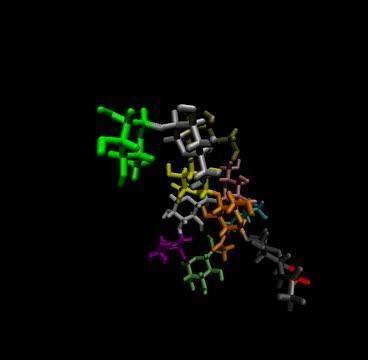
Here are movies of dynamic behavior of a sugar chain on the basis of NMR-validated simulations. This chain has a particular sugar (green circle).
(Photo Credit: © Koichi Kato)
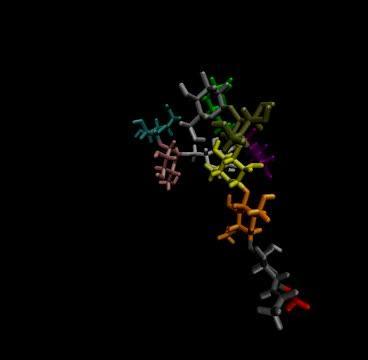
Here are movies of dynamic behavior of a sugar chains on the basis of NMR-validated simulations. This chain does not have a particular sugar.
(Photo Credit: © Koichi Kato)
The Asian monsoon already existed 40 million years ago during a period of high atmospheric carbon dioxide and warmer temperatures, reports an international research team led by a University of Arizona geoscientist.
Scientists thought the climate pattern known as the Asian monsoon began 22-25 million years ago as a result of the uplift of the Tibetan Plateau and the Himalaya Mountains.
"It is surprising," said lead author Alexis Licht, now a research associate in the UA department of geosciences. "People thought the monsoon started much later."
Based on models and observations, climate scientists have devised a simplified formula to describe one of the consequences of climate change: regions already marked by droughts will continue to dry out in the future climate. Regions that already have a moist climate will experience additional rainfall. In short: dry gets drier; wet gets wetter (DDWW).