
The American pika, a small animal with a big personality that has long delighted hikers and backpackers, is disappearing from low-elevation sites in California mountains, and the cause appears to be climate change, according to a new study.
Earth
Inhibiting the action of a particular enzyme dramatically slows the growth of tumor cells tied to BRCA1 and BRCA2 genetic mutations which, in turn, are closely tied to breast and ovarian cancers, according to researchers at NYU Langone Medical Center.
Skeptics who still doubt anthropogenic climate change have now been stripped of one of their last-ditch arguments: It is true that there has been a warming hiatus and that the surface of the earth has warmed up much less rapidly since the turn of the millennium than all the relevant climate models had predicted.
However, the gap between the calculated and measured warming is not due to systematic errors of the models, as the skeptics had suspected, but because there are always random fluctuations in the Earth's climate.
A new study led by scientists at the Woods Hole Oceanographic Institution (WHOI) points to the deep ocean as a major source of dissolved iron in the central Pacific Ocean. This finding highlights the vital role ocean mixing plays in determining whether deep sources of iron reach the surface-dwelling life that need it to survive.
Humans have fewer remnants of viral DNA in their genes compared to other mammals, a new study has found. This decrease could be because of reduced exposure to blood-borne viruses as humans evolved to use tools rather than biting during violent conflict and the hunting of animals.
Galaxies can die early because the gas they need to make new stars is suddenly ejected, research published today suggests.
Most galaxies age slowly as they run out of raw materials needed for growth over billions of years. But a pilot study looking at galaxies that die young has found some might shoot out this gas early on, causing them to redden and kick the bucket prematurely.
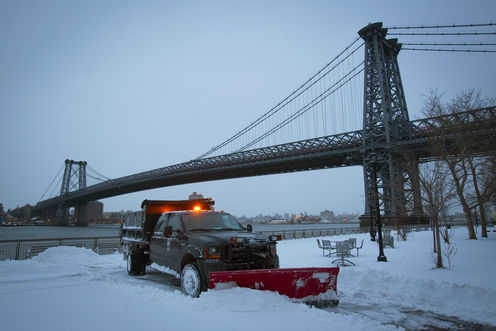
Calm after the storm in New York City. EPA
Why snowfall is one of the hardest predictions for a meteorologist
By Peter Clark, Joint Met Office Chair in Weather Processes at University of Reading
Naturally occurring arsenic in private wells threatens people in many U.S. states and parts of Canada, according to a package of a dozen scientific papers to be published next week. The studies, focused mainly on New England but applicable elsewhere, say private wells present continuing risks due to almost nonexistent regulation in most states, homeowner inaction and inadequate mitigation measures. The reports also shed new light on the geologic mechanisms behind the contamination.
In the course of Earth's dynamic evolution, the drifting of continents mostly initiates along oblique rifts.
Whereas oblique extension is expected to result in a combination of (i) dip-slip along faults with strike orthogonal to the extension direction and (ii) strike-slip displacement along oblique faults, Philippon and colleagues show that in oblique rifts, faults show dip-slip kinematics indicating pure extension irrespective of the fault strike with respect to the regional extension direction.
Zircon, the mineral most widely used to date rocks by the U-Pb method, is common in crustal rocks, but is increasingly being found in rocks from the upper mantle. Several studies have concluded that this reflects the deep subduction of crustal rocks into the mantle.
This paper presents a new explanation for the presence of crustal zircons in the upper mantle rocks. In this case, granitoid-related melts/fluids, injected into already-emplaced mafic-ultramafic rocks, apparently transported pre-existing zircons and possibly crystallized new grains.
Mammoth Cave, Kentucky, is the longest cave system in the world.
Many of the dry passages of the cave are lined with gypsum (CaSO4 * 2H2O), yet despite nearly a century of research, the source of the gypsum sulfur remains uncertain. Identifying the sulfur source is important because it reveals how fluids move through the cave, which helps geologists understand cave formation and engineers understand chemical transport in karst terrains.
Podiform chromitites enclosed in depleted harzburgites of the Luobusa massif (Tibet) contain diamonds and a highly reduced trace-mineral association that suggests that the chromitites formed at ultra-high pressure (UHP) corresponding to the Transition Zone (>400 km; >12.5 GPa). However, trace-element signatures of the chromites are indistinguishable from those of typical ophiolitic chromitites (e.g. Antalya Complex, Turkey), implying primary crystallization from typical arc-type melts at shallow depths. New data on geochronology and Fe oxidation state may explain this conundrum.
The nonlinear and complex behavior of glacier dynamic processes (e.g., surging and ice calving) presents major challenges for future estimates of runoff and sea-level change.
Because direct observations are temporally limited, reconstructions of past fluctuations from glaciers that undergo dynamic advance and/or retreat are valuable.
Humans impact Earth in many different ways. One of the most visually dramatic impacts is erosion caused by deforestation and intensive agriculture -- but does such erosion really matter?
To answer that question, Reusser and colleagues used exquisitely sensitive analyses to measure how quickly Earth's surface changes in the absence of humans. The team estimated natural rates of erosion by collecting sand from rivers draining the southeastern United States and measuring a rare isotope of beryllium produced near Earth's surface.
NASA's RapidScat, GPM and Terra satellite have been actively providing wind, rain and cloud data to forecasters about Tropical Cyclone Eunice. The storm reached Category 5 status on the Saffir-Simpson scale on January 30.
Tropical cyclone Eunice became the fourth tropical cyclone of the 2015 Southern Indian Ocean season when it formed well east of Madagascar on January 27, 2014.