
Despite the attractive electrical properties and physical features of single-walled carbon nanotubes, incorporating them into scalable integrated circuits has proven to be a challenge because of difficulties in manipulating and positioning these molecular scale objects and in achieving sufficient current outputs.
Now, researchers at the University of Illinois, Lehigh University and Purdue University have developed an approach that uses dense arrays of aligned and linear nanotubes as a thin-film semiconductor material suitable for integration into electronic devices.
 High frequency sound waves break ionic liquids into non-toxic components. Image: Chemical Science
 18th c. corset. Credit:
 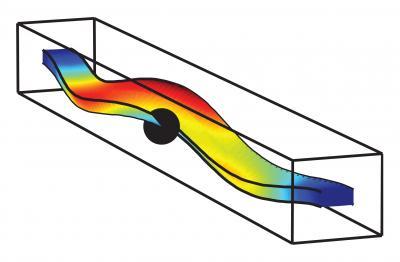 This slow-motion simulation of the JILA nanoscale motion detector shows the wiggling of a floppy metal beam, just 100 nanometers thick, as it is struck by an electric current at the dot.